
Outbreak Information
Outbreak Information
-
Current Active Outbreaks
-
Resolved Outbreaks
Outbreak Type Organism Unit Date Declared Date Resolved Antibiotic Resistant Organism (ARO) VRE Level 2 – 2200 January 16, 2026 March 27, 2026 Antibiotic Resistant Organism (ARO) VRE Level 1 – M200 March 23, 2026 April 10, 2026 Respiratory RSV Lower Level – L500 April 13, 2026 April 22, 2026 Antibiotic Resistant Organism (ARO) VRE Level 2 – CCU March 17, 2026 April 25, 2026 Antibiotic Resistant Organism (ARO) VRE Level 2 – 2300 January 23, 2026 July 09, 2026
Patient and Visitor Outbreak Information
Outbreak measures are put in place when there is evidence of infection transmission to patients on a specific unit, which could spread to other patients. The goal of these measures is to limit the spread of infection throughout the hospital and resolve the outbreak as soon as possible.
Woodstock Hospital is committed to ensuring our patients, their family and caregivers are supported to actively play a role in their care. This section will give you
information about outbreaks on your unit, how to manage them and what to look out for.
For more details on the specific infection causing outbreak on your unit, please click here to access our Infection Control Patient Education, or speak to your care provider.
-
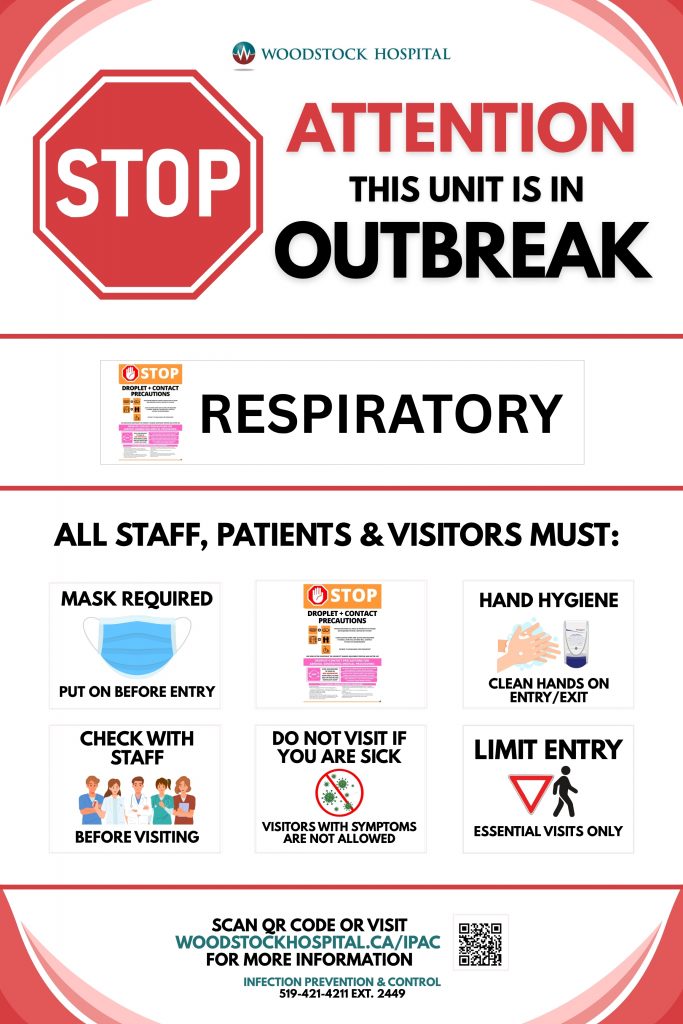
Respiratory Outbreak
Additional Precautions
All patients on a unit in active respiratory outbreak are required to be placed on Droplet + Contact Precautions. This alerts staff to put on proper personal protective equipment, which includes a gown, gloves, a medical mask and eye protection.
Patient Restrictions
- If you are symptomatic, please do not leave your room and ensure you put on a medical mask at all times while outside your room.
- All meals and services will continue to be provided in your room
- Asymptomatic patients are free to move about the unit
- Please do not leave the unit and do not visit other patients
- Hand hygiene must be done before exiting and entering your room.
- If you have any out of hospital appointments at another healthcare facility, the facility must be notified of the outbreak and adhere to outbreak measures as well.
Patient Care
Your care will not be affected as a result of the outbreak. All required services (i.e. physiotherapy, radiology, surgical services, etc.) will continue to be provided. Please be advised that staff members will be wearing a gown, gloves, medical mask and eye protection while providing care to prevent you, other patients, staff and themselves from becoming infected.
Visitor Requirements
- Visitors may be restricted to only one (1) essential visitor
- Please do NOT visit if you are experiencing any respiratory symptoms including cough, stuffy/runny nose, fever, sore throat, etc.
- A visitors must perform hand hygiene before entering and after leaving the patient room
- A hospital-provided medical mask is required for the duration of your visit
- A gown and gloves are only required if a visitor will providing direct care to the patient
- Visitors should only be visiting one patient per visit to the hospital
- If you are symptomatic, please do not leave your room and ensure you put on a medical mask at all times while outside your room.
-
Antibiotic Resistant Organism (ARO) Outbreak
What is an antibiotic resistant organism (ARO)?
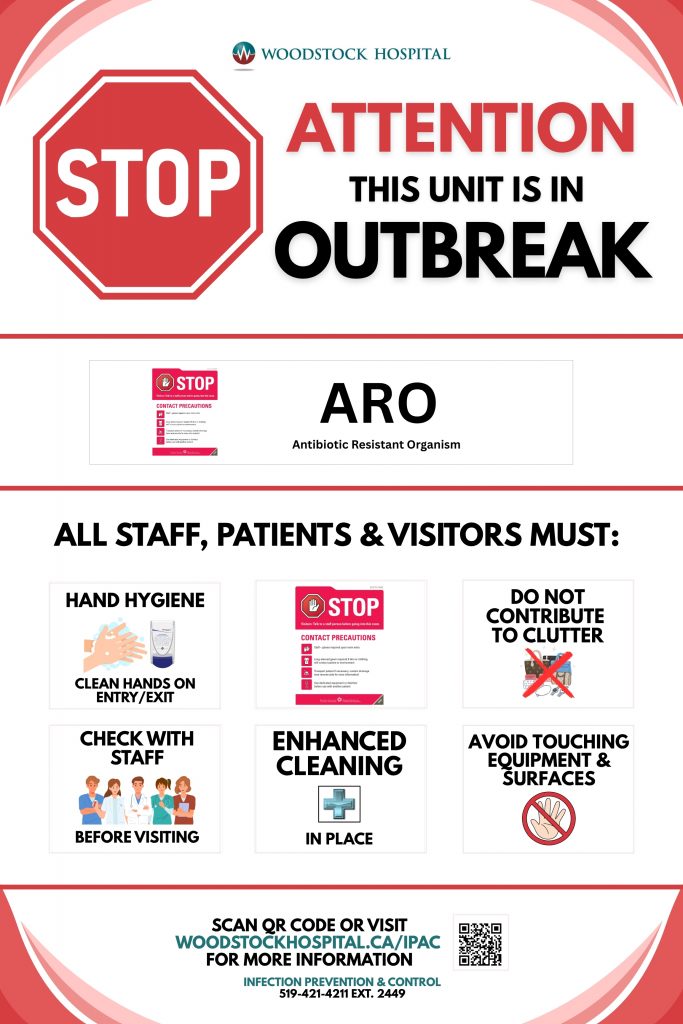
Antibiotic Resistant Organisms (AROs) are bacteria that have become resistant to antibiotic treatment; therefore, antibiotics are no longer effective. These organisms can live in your gut and/or on your skin without showing symptoms, called ‘colonization’, as well as cause active infections. Common AROs that cause outbreaks include methicillin-resistant Staphylococcus aureus (MRSA) and vancomycin-resistant Enterococcus (VRE). Both colonization and active infection can be spread through direct, person-to person contact, or indirect contact from contaminated surfaces, or unwashed hands.
Additional Precautions
Any patients who have an active infection or is colonized with an ARO will be placed on contact precautions. This alerts staff to put on proper personal protective equipment (PPE) when providing direct care or cleaning the room PPE for contact precautions include a gown and gloves.
Patient Restrictions
- Patients are free to move about the unit, but please do not visit other patients
- Hand hygiene must be done before exiting and entering your room.
- If you have any out of hospital appointments at another healthcare facility, the facility must be notified of the outbreak and adhere to outbreak measures as well.
Patient Care
Your care will not be affected as a result of the outbreak. All required services (i.e. physiotherapy, radiology, surgical services, etc.) will continue to be provided.
- Staff members will be wearing a gown and gloves while providing care to prevent you, other patients, other staff and themselves from becoming infected.
- The following increased care measures will take place during your stay:
- Specialized wipes will be used and/or provided for daily use. These help to kill any of the ARO bacteria that may be on your skin
- The swabs you received upon admission to the hospital will be collected weekly to assess ongoing transmission of the specific outbreak organism
Visitor Requirements
- Visitors may be restricted to only one (1) essential visitor
- A visitors must perform hand hygiene before entering and after leaving the patient room
- A hospital-provided medical mask is required for the duration of your visit
- A gown and gloves are only required if a visitor will providing direct care to the patient
- Visitors should only be visiting one patient per visit to the hospital
Environmental Cleaning
- Environmental Services (housekeeping) staff will be conducting increased cleaning of high-touch services throughout the unit
-
C. difficile Outbreak
What is C. difficile?
Clostridioides difficile (C. difficile) is a type of antibiotic-resistant bacteria that can live in the bowel. About 1–3% of people carry these bacteria without symptoms. However, when someone takes antibiotics, the normal balance of bacteria in the gut can be disrupted, which can allow C. difficile to grow and cause diarrhea and other gastrointestinal symptoms
Additional Precautions
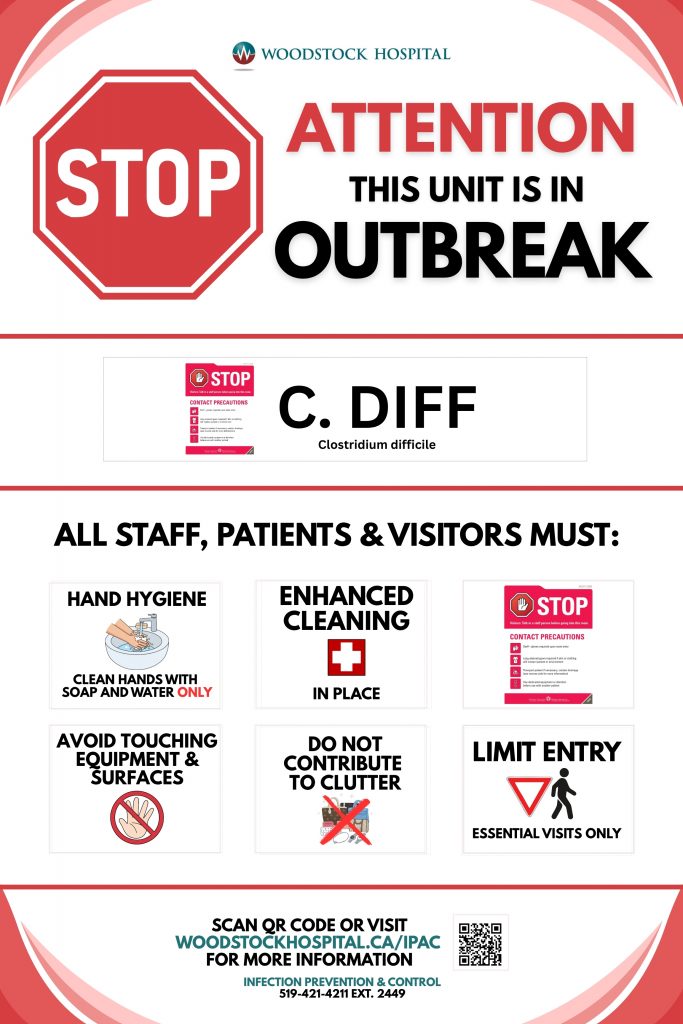
Any patients who are showing symptoms of or are confirmed to have a C. difficile infection (CDI) will be placed on Contact Precautions. This alerts staff to put on proper personal protective equipment (PPE) when providing direct care or cleaning the room. PPE for contact precautions include a gown and gloves.
Contact precautions will remain in place until a minimum of 48 hours have passed without showing symptoms of a CDI.
Patient Restrictions
- Hand hygiene strictly with soap and warm water must be done before exiting and entering your room.
- Alcohol-based hand sanitizer is unable to kill C. difficile bacteria.
- If you are symptomatic, we ask that you please remain in your room
- All meals and services will continue to be provided in your room
- Asymptomatic patients are free to move about the unit
- Please do not leave the unit and do not visit other patients
- If you have any out of hospital appointments at another healthcare facility, the facility must be notified of the outbreak and adhere to outbreak measures as well.
Patient Care
Your care will not be affected as a result of the outbreak. All required services (i.e. physiotherapy, radiology, surgical services, etc.) will continue to be provided.
- Staff members will be wearing a gown and gloves while providing care to prevent you, other patients, other staff and themselves from becoming infected.
Visitor Requirements
- Visitors may be restricted to only one (1) essential visitor
- Please do NOT visit if you are experiencing any unexplained nausea, vomiting or diarrhea.
- All visitors must perform hand hygiene strictly with soap and water before entering and after leaving the patient room
- Alcohol-based hand sanitizer is unable to kill C. difficile bacteria.
- A gown and gloves are only required if a visitor will providing direct care to the patient
- Please do not eat or drink while in the patient’s room.
- Visitors should only be visiting one patient per visit to the hospital
Environmental Cleaning
- Environmental Services (housekeeping) staff will be conducting increased cleaning of high-touch services throughout the unit with bleach (our regular hydrogen peroxide cleaner is unable to kill C. difficile bacteria)
- Hand hygiene strictly with soap and warm water must be done before exiting and entering your room.
-
Gastrointestinal Outbreak
Additional Precautions
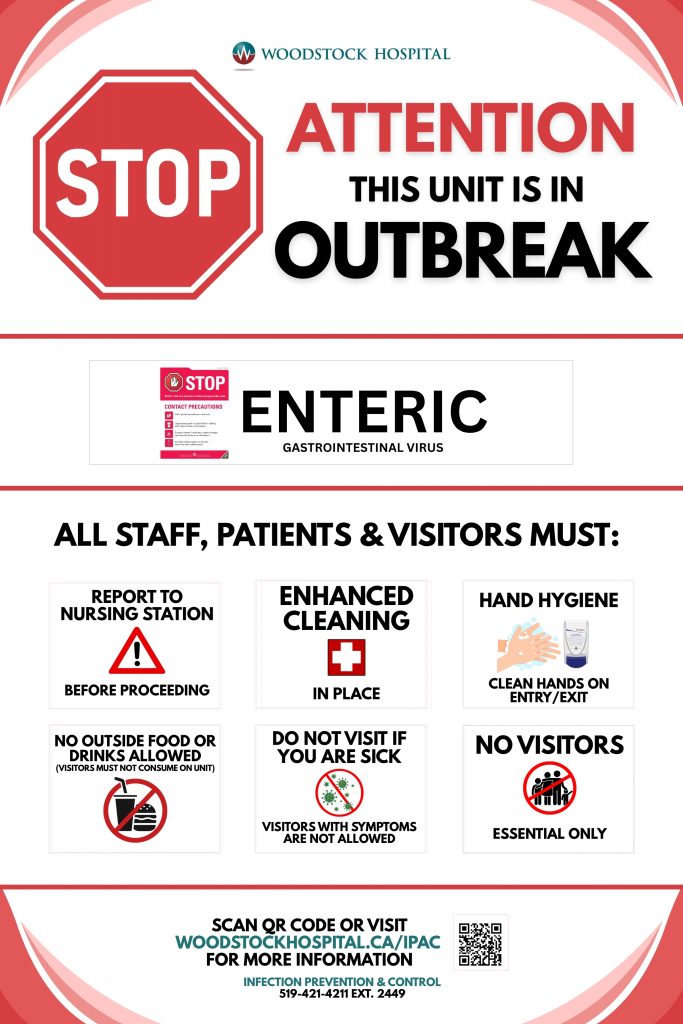
All patients on a unit in active gastrointestinal outbreak are required to be placed on Contact Precautions. This alerts staff to put on proper personal protective equipment (PPE) when providing direct care or cleaning the room. PPE for contact precautions include a gown and gloves.
Contact precautions will remain in place until a minimum of 48 hours have passed without showing symptoms of a gastrointestinal infection (i.e. diarrhea, nausea, vomiting).
Patient Restrictions
- Hand hygiene strictly with soap and warm water must be done before exiting and entering your room.
- Alcohol-based hand sanitizer is unable to kill C. difficile bacteria.
- If you are symptomatic, we ask that you please remain in your room
- All meals and services will continue to be provided in your room
- Asymptomatic patients are free to move about the unit
- Please do not leave the unit and do not visit other patients
- If you have any out of hospital appointments at another healthcare facility, the facility must be notified of the outbreak and adhere to outbreak measures as well.
Patient Care
Your care will not be affected as a result of the outbreak. All required services (i.e. physiotherapy, radiology, surgical services, etc.) will continue to be provided.
- Staff members will be wearing a gown and gloves while providing care to prevent you, other patients, other staff and themselves from becoming infected.
- Symptomatic patients may receive a specialized diet to support the gastrointestinal system, as it can become sensitive during a gastrointestinal infection.
Visitor Requirements
- Visitors may be restricted to only one (1) essential visitor
- Please do NOT visit if you are experiencing any unexplained nausea, vomiting or diarrhea.
- All visitors must perform hand hygiene strictly with soap and water before entering and after leaving the patient room
- A gown and gloves are only required if a visitor will providing direct care to the patient
- Please do not eat or drink while in the patient’s room.
- Visitors should only be visiting one patient per visit to the hospital
Environmental Cleaning
- Environmental Services (housekeeping) staff will be conducting increased cleaning of high-touch services throughout the unit
- Hand hygiene strictly with soap and warm water must be done before exiting and entering your room.
© 2026 Woodstock Hospital. All rights reserved.